

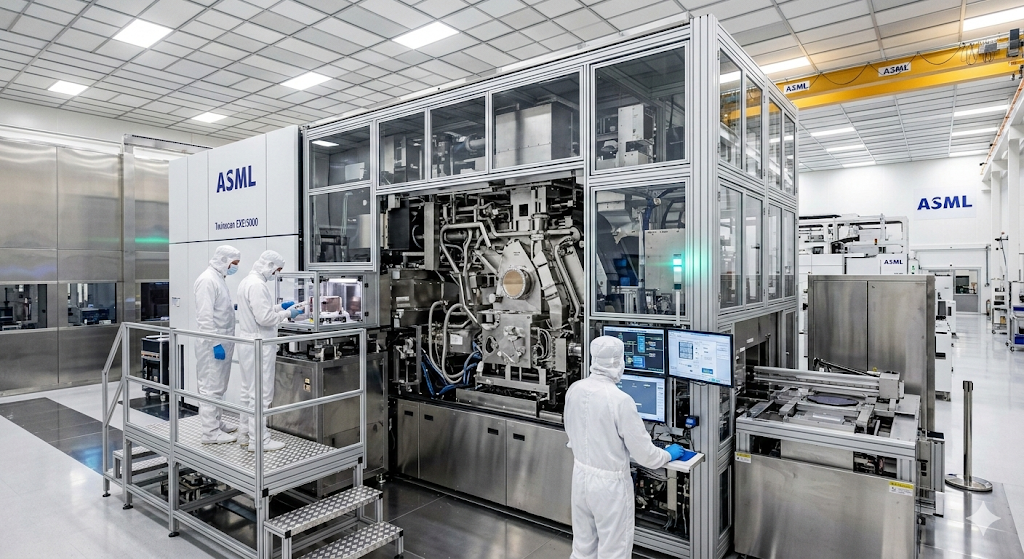
ASML Holding N.V. (ASML) is a business based in the Netherlands that defines “high quality.” As the sole provider of the lithography machines required to manufacture the world’s most advanced semiconductors, ASML’s business model is centered on its role as the exclusive provider of the world’s most advanced lithography systems, which are essential for manufacturing of nearly all modern microchips. By controlling the “bottleneck” of semiconductor production, ASML operates a “picks and shovels” model for the entire digital economy, particularly the AI and high-performance computing sectors.
ASML generates revenue through two main segments. The first is through net systems sales (75% of revenue). This involves the sale of new and used lithography machines. EUV (Extreme Ultraviolet) are ASML’s most advanced machines, costing approximately $370 million to $380 million per system. They are the only tools capable of etching patterns small enough for 2nm, 1.4nm, and 1nm chips. DUV (Deep Ultraviolet) machines are used for less advanced chips found in cars, appliances, and older smartphones. The second is through installed base management (25% of revenue). This is a high-margin, recurring revenue stream consisting of service, maintenance, and field upgrades for the thousands of machines already operating in customer factories.
ASML holds a near-100% market share in EUV lithography. Because major chipmakers like TSMC, Samsung, and Intel cannot manufacture leading-edge chips without these machines, ASML possesses extraordinary pricing power. This is reflected in their gross margins, which typically range between 51% and 53%.
The business model is protected by immense barriers to entry. ASML reinvested €4.7 billion into R&D in 2025 alone to maintain its technological lead. The company manages over 5,100 suppliers to build a single machine, which contains over 100,000 parts. This creates a “moat” that competitors like Nikon or Canon have been unable to cross for advanced nodes.
ASML consistently generates return on invested capital that exceeds 40% often hovering between 40% and 50% in high-growth years. This aligns with the value investing philosophy that long-term stock returns track ROIC. For fiscal year 2025, ASML reported an operating income of approximately $12.79 billion on sales of $36.96 billion (approx. €32.7 billion), representing an operating margin of roughly 34.6%.
Annual revenue grew from $29.8 billion in 2023 to $36.96 billion in 2025. Earnings per share have shown significant long-term growth, rising from $20.82 in 2024 to a projected $27.96 in 2025.The company aggressively returns capital via stock buybacks, completing a €7.6 billion repurchase program in December 2025 and announcing a new €12 billion program through 2028. Companies that implement stock buyback tend to compound capital at a higher rate because it reduces the number of shares outstanding and increases EPS. It is like buying out your business partner so you get to keep more of the profits as the business owner.
ASML is a prolific generator of FCF, reporting $9.85 billion in 2024, which supports its heavy R&D and shareholder returns. ASML balance sheet and debt to equity ratio is exceptionally conservative with a debt-to-equity ratio of only 14.2% as of late 2025.
ASML holds a virtual monopoly on Extreme Ultraviolet (EUV) lithography. The machines are so complex that they are often described as the most complicated devices ever made. With over 30 years of R&D and thousands of patents, the barriers to entry are practically insurmountable. Because TSMC, Intel, and Samsung must have these machines to stay competitive, ASML possesses extraordinary pricing power.
Led by CEO Christophe Fouquet, the company is generally viewed as well-governed, though some internal reviews mention a high-pressure, bureaucratic environment typical of large-scale engineering firms. While the technology is complex, the business model is simple: ASML builds the “toll booths” for the entire digital economy.
What are the extrinsic risks? This is where ASML has exposure as a business. ASML is a central “geopolitical chess piece” in the US-China trade war. Restrictions on selling EUV and advanced DUV machines to China represent a significant, uncontrollable external factor that can impact performance.
In terms of valuation, ASML appears to be fairly valued. There is no margin of safety. As of the most recent market data in March 2026, the ADR price per share is $1,292.80. My estimate of ASML’s intrinsic value is about $1,1666.61 per share making the stock price about 10% over valued. However, sometimes you need to pay up to buy into a high-quality business such as ASML.
Kenneth U. Reyes is CEO and Portfolio Manager at Reyes Capital Management, LLC which manages a long term value oriented private investment fund. He is also founder of the Law Offices of Kenneth U. Reyes, APC, a five lawyer boutique law firm in Los Angeles specializing in Family Law. He can be reached at (213) 500-4836. kr@reyescapitalmanagement.com. 3699 Wilshire Blvd., Suite 747, Los Angeles, CA 90010.

Related Resources

December 3, 2025
Early in my career as a practicing lawyer in Los Angeles some 25 years ago, I used to look forward to receiving the print subscription of the Daily Journal which lays out all the new appellate cases by practice area. However, as the years passed and technology advanced, I found easier ways of accessing those cases online. The story of the Daily Journal Corporation (DJCO) is a classic demonstration of legendary investor Charlie Munger’s capital allocation genius and strategic foresight.

September 1, 2025
A lot of people have a grand idea about the next big thing, and they'll get all worked up about a company's past successes and future projections. The truth is, the world is full of companies that had a good run but couldn't keep it up. What's important is the business itself, its competitive position, and the people running it. Let's take a look at Adobe, a company that has been a long-time fixture in the world of creative software.

January 31, 2025
Is Arista Networks a great business? Arista Networks is a business that reflects solid business fundamentals and consistent revenue and operating income growth since it became a public company in June 2014. It is therefore worth taking a further look into this business. Simple business models with a long track record are more predictable and less likely to be subject to disruption. Arista does not operate a simple and predictable business. It is a networking equipment provider.
December 3, 2025
Early in my career as a practicing lawyer in Los Angeles some 25 years ago, I used to look forward to receiving the print subscription of the Daily Journal which lays out all the new appellate cases by practice area. However, as the years passed and technology advanced, I found easier ways of accessing those cases online. The story of the Daily Journal Corporation (DJCO) is a classic demonstration of legendary investor Charlie Munger’s capital allocation genius and strategic foresight.
September 1, 2025
A lot of people have a grand idea about the next big thing, and they'll get all worked up about a company's past successes and future projections. The truth is, the world is full of companies that had a good run but couldn't keep it up. What's important is the business itself, its competitive position, and the people running it. Let's take a look at Adobe, a company that has been a long-time fixture in the world of creative software.
January 31, 2025
Is Arista Networks a great business? Arista Networks is a business that reflects solid business fundamentals and consistent revenue and operating income growth since it became a public company in June 2014. It is therefore worth taking a further look into this business. Simple business models with a long track record are more predictable and less likely to be subject to disruption. Arista does not operate a simple and predictable business. It is a networking equipment provider.
